---
title: Relationships & Structure of Documents & Fields
description: Relation between documents and fields to get structured information to a document, this relationship is the basis for most integrations. Some API examples and worthy next reads are also included in this article.
---
[Skip to content](https://support.parashift.io/relationships-structure-of-documents-fields#main-content)
[Contact us](https://support.parashift.io/kb-tickets/new?hsLang=en) [Customer support portal](https://support.parashift.io/tickets-view?hsLang=en)
[](https://support.parashift.io/?hsLang=en)
Open main navigation
Close main navigation
- [Contact us](https://support.parashift.io/kb-tickets/new)
- [Customer support portal](https://support.parashift.io/tickets-view)
How can we help you?
- There are no suggestions because the search field is empty.
1. [Support Center](https://support.parashift.io/?hsLang=en)
2. [API Documentation](https://support.parashift.io/api-documentation?hsLang=en)
3. [Technical API Documentation](https://support.parashift.io/api-documentation?hsLang=en#technical-api-documentation)
# Relationships & Structure of Documents & Fields
## Relation between documents and fields to get structured information to a document, this relationship is the basis for most integrations. Some API examples and worthy next reads are also included in this article.
### Introduction
The Parashift Platform is designed to extract information from any kind of document. Depending on use case, clients can have one, two, or hundreds of document types (configurations) active, each with maybe similar or unique data points to be extracted.
It is therefore very important to have a standardized way to output all this captured information. This article describes the relationship between documents and fields and gives some examples of how to best download results via API.
### Relationships & Structure
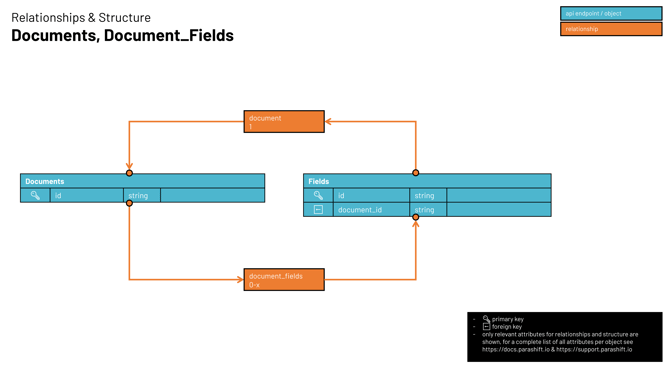
In a nutshell, the following diagram shows how the different objects (documents and document\_fields) are linked with each other.
### Main takeaways
- One document consists of zero or multiple document\_fields, while a document\_field is always linked to one document.
### Example API Calls
#### One document with its document\_fields
```
GET /documents/123456/?include=document_fields
```
#### Alternative: All document\_fields belonging to one document
```
GET /document_fields/?filter[document_id]=123456&include=document
```
#### One document with its document\_fields and their extraction\_canidates
```
GET /documents/123456/?include=document_fields&extra_fields[document_fields]=extraction_candidates
```
#### All the documents and their classification\_candidates
```
GET /documents/?extra_fields[documents]=classification_candidates
```
#### One document with recognition\_text (ocr)
```
GET /documents/123456/?extra_fields[documents]=recognition_text
```
- [Getting Started](https://support.parashift.io/getting-started?hsLang=en)
- [User Guides](https://support.parashift.io/user-guides?hsLang=en#main-content)
- [General](https://support.parashift.io/user-guides?hsLang=en#general)
- [Validation](https://support.parashift.io/user-guides?hsLang=en#validation)
- [Platform Workshops](https://support.parashift.io/user-guides?hsLang=en#platform-workshops)
- [Configuration Guides](https://support.parashift.io/configuration-guides?hsLang=en#main-content)
- [Document Type & Fields](https://support.parashift.io/configuration-guides?hsLang=en#document-type-fields)
- [Automation](https://support.parashift.io/configuration-guides?hsLang=en#automation)
- [Tenant (User management)](https://support.parashift.io/configuration-guides?hsLang=en#tenant-user-management)
- [Workflow (Upload Configuration, Separation, Classification)](https://support.parashift.io/configuration-guides?hsLang=en#workflow-upload-configuration-separation-classification)
- [Release Notes](https://support.parashift.io/release-notes?hsLang=en)
- [API Documentation](https://support.parashift.io/api-documentation?hsLang=en#main-content)
- [Platform API Configuration](https://support.parashift.io/api-documentation?hsLang=en#platform-api-configuration)
- [Technical API Documentation](https://support.parashift.io/api-documentation?hsLang=en#technical-api-documentation)
- [Professional Services](https://support.parashift.io/professional-services?hsLang=en#main-content)
- [Project-based Service Packages](https://support.parashift.io/professional-services?hsLang=en#project-based-service-packages)
- [Subscription-based Service Packages](https://support.parashift.io/professional-services?hsLang=en#subscription-based-service-packages)
[](https://support.parashift.io/?hsLang=en)
[Platform Live Status](https://status.parashift.io/) | [API Documentation](https://docs.parashift.io/)
[mailto:support@parashift.io](mailto:support@parashift.io)
Copyright © 2025, Parashift AG